I know it's hopeless ... but ... I can't help hoping ... that maybe the contract will fall over ...
http://www.realestate.com.au/cgi-bin/rsearch?a=o&id=7200785&f=0&p=10&t=r
And if it doesn't happen ... then what ... should we proceed with trying to buy the lower end of the creek?
*puts in too hard basket for tonight*
25 June 2008

21 June 2008
I dithered ...
... and missed out.
I was too uncertain to proceed without Trevor's active encouragement ... and missed out on this block.
http://www.realestate.com.au/cgi-bin/rsearch?a=o&id=7200785&f=0&p=10&t=r
It adjoins our own block and could have added two real purposes to it.
One would have been some productivity of a horticultural nature and the other, to have extended the creek connection.
What a sook I am; but Trevor is so unwell and it is hard to focus o practical things.
This is a one off though.
I should have taken the chance.
Oh well ...
10 September 2007
The drive in ...
Yes, even the drive in to the block is interesting ... well _I_ like it.
 When we turn off the main road we are suddenly more alert, and not just to avoid channels worn by the winter rains.
The varied ant nests alone are worth watching, even if only to check the damage done by echidnas since our last visit.
In Summer the reptiles are out too; snakes, lizards and goannas.
 "Road kill" is frequent and remains are soon cleaned up by the many ants.
Did this animal crawl off the road before it curled up and died?
The chief attraction is the birds, though they are so quick to hide.

The fleeting glimpses invite long, quiet walks with the camera.
Evenings are spent trying to match photographs taken, with those in books.
:)
9 September 2007
Spring Time
We have been asked many times, "What is the best time of year to come over?"
To date we have never felt able to say any one time over the others, convincingly. Whenever we go, that seems to be "the best" time.
After this visit though, we will be saying "Come in the Spring Time, if you have a choice."
Have I ever mentioned the view from the verandah?
In Spring, the sun rises over the Pages, two islands on the horizon.

http://www.parks.sa.gov.au/the_pages/index.htm

The day begins with the birds' dawn chorus, so make it a Spring sunrise (while occasional ships sail by) and it is a joy all round.
The range of birds, always so easily heard, are more active and so more easily seen than usual and the wildflowers are as colourful and as plentiful as the birds too.
The water of this past winter was still apparent in the free flowing creek and damp surrounds.
The sunshine wasn't so hot that we needed protective gear, and even the beach seemed more dynamic; to have been subjected to bigger than usual forces with changes in sand levels among the beautiful rocks.
Though we didn't see any echidnas, we saw their ant nest destruction all over the place. There were reptile tracks (large-ish and tiny) too, to say nothing of the Little Penguin tracks down at the beach. Possums, wallabies and kangaroos were discreet but welcome visitors as well.
We were thrilled to see a wedge tail eagle pair circling the sky in style, and a pair of Kestrels. I was able to record bird songs, a first for me, and now it only remains for me to learn how to include them in a blog.
:)
All in all, a magic start to the Spring of 2007.
8 September 2007
It's been a while ...
... since we spent more time than was strictly necessary over on KI. The spiders tried tying the gate shut.

We go regularly, but generally for short stints.
This time we took plenty of time and really enjoyed it.
What did we do?
We checked the fences :)

Among the welcome sights was this old friend who looked back at us fom over the wire gate that he routinely clears.


We go regularly, but generally for short stints.
This time we took plenty of time and really enjoyed it.
What did we do?
We checked the fences :)

Among the welcome sights was this old friend who looked back at us fom over the wire gate that he routinely clears.

19 August 2007
A change is as good as a holiday, they say.
So I have tried a few changes.
To the right there is a new flickr doodad, which is linked to my own set of Kangaroo Island phots.
Now, I do really know very well that I am not a Photographer, but I am progressing and I hope they might give you some idea of our little corner of that part of the world.
If it does more, such as encourage YOU to come over and take your own photos, I would be delighted.
There is a Flickr Group called "Kangaroo Island", should you be interested.
http://www.flickr.com/groups/34811648@N00/pool/
5 August 2007
Scarlet Robin, it is.

This is the male Scarlet Robin; Petroica multicolor.
I am still learning to distinguish the females from the juveniles and the Red-capped from the Scarlet.
It's fun learning though.
:)
2 August 2007
Birds in the bush (of the dunes)
 The bush on the dunes is not immediately inspiring if you look at individual specimens as if they were garden specimens.
Taken as a whole though, the shifts of light as the day progresses (and weather) and the resulting progression of changes in clours and textures, of sounds and even smells is striking.
The straggly plants are perfect foils for the tiny birds.
During the winter months we often see robins.
I am not a birder, so would be glad of some help with identifications.
This might be an immature Red-capped Robin, Petroica goodenovii .

The Readers Digest book of birds says that they, "resemble adult female but lack red-brown forehead. Young males have some red wash have some red wash on breast. Juveniles finely streaked or mottled brown and buff-white".
On the other hand, there is a slight indication of white across the top of the beak.
It could be an immature Scarlet Robin, Petroica multicolour.
31 July 2007
... and further to rubbish ...
The walk to and from the beach through the dunes is beautiful and one of our strongest memories of each day's visit to the beach.
We always take home any rubbish that we find on the beach.

We always hear and generally see wrens, honey eaters and flycatchers.
In winter robins are there as well.
There are always tracks of wallabies and kangaroos, and if we don't see the animals themselves, we hear one or two bounding away as we approach.
In the summer there are goannas, or just their tracks.
Once on the beach, we see a range of the common shore birds.
The plants are typical dune plants; straggly shrubs, tapering off to low ground hugging "herbs" and grasses once you reach the beach itself.
One of my favourite dune plants has been the Sea Spurge.

... or it was a favourite, until recently.
Now I know it is a weed, "Sea Spurge", or Euphorbia paralias.
Apprently it is a pest around much of Australia's coast, from Western Australia to NSW.
http://www.nationalparks.nsw.gov.au/npws.nsf/Content/dec_media_050307_actionspurge
At Antechamber Bay it tapers off about where the Bridal Creeper extends into the dunes.
:(
We always take home any rubbish that we find on the beach.

We always hear and generally see wrens, honey eaters and flycatchers.
In winter robins are there as well.
There are always tracks of wallabies and kangaroos, and if we don't see the animals themselves, we hear one or two bounding away as we approach.
In the summer there are goannas, or just their tracks.
Once on the beach, we see a range of the common shore birds.
The plants are typical dune plants; straggly shrubs, tapering off to low ground hugging "herbs" and grasses once you reach the beach itself.

One of my favourite dune plants has been the Sea Spurge.

... or it was a favourite, until recently.
Now I know it is a weed, "Sea Spurge", or Euphorbia paralias.
Apprently it is a pest around much of Australia's coast, from Western Australia to NSW.
http://www.nationalparks.nsw.gov.au/npws.nsf/Content/dec_media_050307_actionspurge
At Antechamber Bay it tapers off about where the Bridal Creeper extends into the dunes.
:(
Discovery Bay Detour
After telling about our first glimpses of Discovery Bay, I went looking for a photo of it.
This is one of the photos that we took at the time.
 We walked for what seemed miles ... and there was no end to the rubbish.
Here is the Google image search page for Discovery Bay.
http://www.sciencemusings.com/blog/2007/07/here-come-ducks.html
It is a magnificent place to visit.
Perhaps you could go prepared (with a wagon :)) to carry more stuff back.
Perhaps it is all clean now?
We decided that it must be named "Discovery Bay" because so much of what is lost at sea washes up there to be discovered.
:)
I wonder if any of these ducks will join the junk?
from http://www.sciencemusings.com/blog/2007/07/here-come-ducks.html
The ducks seem to have spent their first years of freedom drifting counterclockwise in the North Pacific Subtropical Gyre.
Some of the silent quackers escaped the gyre and found their way to Japan and Indonesia.
Others peeled off to the north, slipped through the Bering Straits, and found themselves trapped in Arctic Ice. They moved with the floes across the Arctic Ocean towards Greenland and Iceland, where, released by melting, they joined the currents of the North Atlantic.
By 2001, yellow ducks were showing up in Newfoundland, then down along the Eastern Seaboard of the United States. Here, presumably, some were snatched away by the Gulf Stream and carried towards Europe. This past week, the first duck was apparently found on a British beach in Devon by a retired school teacher named Penny Harris.
And so, and so -- I walk the beaches here in Kerry with a wary eye.
What could be more thrilling than finding a yellow duck, with the "First Years" logo, that had spent fifteen years on an ocean swim of many thousands of miles? Our prevailing winds and currents come from the east, sometimes bringing North American birds and even butterflies to our shores.
I have previously suggested on this site that the arrival of strange creatures out of the sea may have been a reason why early Irish myths all speak of an exotic land out there in the Western Ocean -- the Land of the Blessed that inspired Saint Brendan and his companions to launch themselves upon their legendary 6th-century voyage in a boat not unlike the one pictured here yesterday.
If we didn't know about the Pacific storm and battered container ship, what curious Hy-Brasil would we imagine was the source of a flotilla of yellow plastic ducks."
Yay for science blogs :)
This is one of the photos that we took at the time.
 We walked for what seemed miles ... and there was no end to the rubbish.
Here is the Google image search page for Discovery Bay.
http://www.sciencemusings.com/blog/2007/07/here-come-ducks.html
It is a magnificent place to visit.
Perhaps you could go prepared (with a wagon :)) to carry more stuff back.
Perhaps it is all clean now?
We decided that it must be named "Discovery Bay" because so much of what is lost at sea washes up there to be discovered.
:)
I wonder if any of these ducks will join the junk?
from http://www.sciencemusings.com/blog/2007/07/here-come-ducks.html
Thursday, July 19, 2007
Here come the ducks!
You will remember the consignment of 30,000 yellow plastic ducks that were swept from a container ship by a storm in the North Pacific Ocean in 1992. They have subsequently been adrift, and oceanographers have followed their progress as a way of mapping winds and ocean currents.
The ducks seem to have spent their first years of freedom drifting counterclockwise in the North Pacific Subtropical Gyre.
Some of the silent quackers escaped the gyre and found their way to Japan and Indonesia.
Others peeled off to the north, slipped through the Bering Straits, and found themselves trapped in Arctic Ice. They moved with the floes across the Arctic Ocean towards Greenland and Iceland, where, released by melting, they joined the currents of the North Atlantic.
By 2001, yellow ducks were showing up in Newfoundland, then down along the Eastern Seaboard of the United States. Here, presumably, some were snatched away by the Gulf Stream and carried towards Europe. This past week, the first duck was apparently found on a British beach in Devon by a retired school teacher named Penny Harris.
And so, and so -- I walk the beaches here in Kerry with a wary eye.
What could be more thrilling than finding a yellow duck, with the "First Years" logo, that had spent fifteen years on an ocean swim of many thousands of miles? Our prevailing winds and currents come from the east, sometimes bringing North American birds and even butterflies to our shores.
I have previously suggested on this site that the arrival of strange creatures out of the sea may have been a reason why early Irish myths all speak of an exotic land out there in the Western Ocean -- the Land of the Blessed that inspired Saint Brendan and his companions to launch themselves upon their legendary 6th-century voyage in a boat not unlike the one pictured here yesterday.
If we didn't know about the Pacific storm and battered container ship, what curious Hy-Brasil would we imagine was the source of a flotilla of yellow plastic ducks."
Yay for science blogs :)
30 July 2007
Beach Litter
Years ago, when I was a teacher, Trevor and I went with friends to Discovery Bay, not far from Portland, Victoria (Australia).
It was a magnificent stretch; the beach was difficult to reach and we had to walk in ... a long and arduous trek through the dunes.
When we finally came out onto the deserted beach we got the shock of our lives; despite the isolation it was strewn with rubbish as far as we could see.
Every step we took, we reached yet another piece.
There were ropes and bottles (as you might expect), plastic and metal containers of all sizes and for a range of household and industrial purposes as well as from many different countries; there were light bulbs and a piece of carpet. There was even a container half full of carpet cleaner.
The four of us collected as much as we could carry and took it back, and the resuling heap placed in the middle of our classroom floor was the impetus for our International Year of the Oceans study.
Antechamber Bay does not have that level of littering though there are many more people accessing it directly and ships passing nearby frequently. My guess is that the local ocean currents carry most litter away to some other place, but there is enough.
A favourite piece is this little "broom".
Although it is litter, it is beautifully made.
We enjoy using it at our Kangaroo Island home.
Recycling with a difference.
:)
It was a magnificent stretch; the beach was difficult to reach and we had to walk in ... a long and arduous trek through the dunes.
When we finally came out onto the deserted beach we got the shock of our lives; despite the isolation it was strewn with rubbish as far as we could see.
Every step we took, we reached yet another piece.
There were ropes and bottles (as you might expect), plastic and metal containers of all sizes and for a range of household and industrial purposes as well as from many different countries; there were light bulbs and a piece of carpet. There was even a container half full of carpet cleaner.
The four of us collected as much as we could carry and took it back, and the resuling heap placed in the middle of our classroom floor was the impetus for our International Year of the Oceans study.
Antechamber Bay does not have that level of littering though there are many more people accessing it directly and ships passing nearby frequently. My guess is that the local ocean currents carry most litter away to some other place, but there is enough.

A favourite piece is this little "broom".
Although it is litter, it is beautifully made.
We enjoy using it at our Kangaroo Island home.
Recycling with a difference.
:)
Randomising? Not quite.
It's been so long since I wrote here and lots has happened.
 I couldn't decide whether to start where I left off (back at the beginning of the year? I don't think so!) or just pick and choose the things that come to mind as I think about the intervening time. As you can tell, the latter got the nod.
So, where are we?
Here, midway between Penneshaw and Cape Willoughby.
And turning to look back the other way we see ... saw (in January) ... the steep, roadway that leads down to Antechamber Bay.
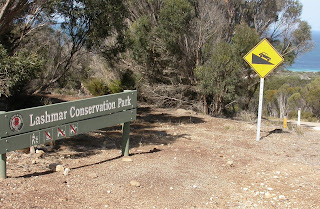
We all go down this track to the beach every day, or almost every day.
Sometimes, left to our own initiative (or lack of it) Trevor and I would be willing to just curl up in front of the fire with a book, but then we think that is something we can do at home ... ...
OOPS!
I was going to say that we can do that at home when it is cold and blustery outside (like this past holiday in July) but I had already begun thinking about _January_ 2007!
So, I see I began with a chronological approach, despite thinking I was not going to ... way back at the beginning of the year in fact!
Oh well ... we will just have to see how long that lasts.
:)
 I couldn't decide whether to start where I left off (back at the beginning of the year? I don't think so!) or just pick and choose the things that come to mind as I think about the intervening time. As you can tell, the latter got the nod.
So, where are we?
Here, midway between Penneshaw and Cape Willoughby.
And turning to look back the other way we see ... saw (in January) ... the steep, roadway that leads down to Antechamber Bay.

We all go down this track to the beach every day, or almost every day.
Sometimes, left to our own initiative (or lack of it) Trevor and I would be willing to just curl up in front of the fire with a book, but then we think that is something we can do at home ... ...
OOPS!
I was going to say that we can do that at home when it is cold and blustery outside (like this past holiday in July) but I had already begun thinking about _January_ 2007!
So, I see I began with a chronological approach, despite thinking I was not going to ... way back at the beginning of the year in fact!
Oh well ... we will just have to see how long that lasts.
:)
It's been so long ...
 Our Island house has been well occupied this year; Trevor and I go over on our own sometimes and other times with friends (including children and grandchildren) .
The house is on a rise above and to the west of Antechamber Bay and looks east out over it.
The mainland of South Australia is visible across the water.
We also look out to The Pages, and watch their light at night. During the day we keep track of the sea-going traffic.
The house is built on an almost paddock, between two scrub lots; one of only an acre or two and the other of 160 acres. They are both beaut for exploring.
Does this still work?
*tap tap tap*
*wipes screen*
oh ... yes ... :)
"cooeeeeees?" through blogland.
*goess off to work out how long it's been and where to start again ... with a coffee (yes, instant :)))
*wipes screen*
oh ... yes ... :)
"cooeeeeees?" through blogland.
*goess off to work out how long it's been and where to start again ... with a coffee (yes, instant :)))
1 March 2007
Waypoints
I mentioned way back there *points way back there* that our children gave us a GARMIN etrex, for plotting things on maps.
We think we have worked it out and so now the snake's tree has an official Waypoint Number, 67.
 Unless there is a better way, I am setting the waypoint, and then photographing the details AND the location of the unit.
(Can you see it?)
That way each point will have its own complete set of information, against the day that my memory completely fails.
:)
Now I only have to work out why the location doesn't work with Google Earth ... I am learning about "off sets".
grrrrr
28 February 2007
The Snake's Tree in Summer, 2007

The snake's tree, taken 23rd January, 2007
The low and brighter green bush is Acacia paradoxa.
The Snake's Tree

Here are two more detailed photographs of the tree that the snake went into, but *without the snake.
I ought to be identifying these trees.
I call myself an Australian and I cannot even distinguish one Eucalypt from another.
The top photo was taken in November.
Another question has been asked about the identity of the deep green climbing plant that the snake is climbing through. (it is intertwined with Bridal Creeper weed)
 This second photo was taken in July 2005, that is, in the winter after I saw the snake.
The only creeper in evidence is the Bridal Creeper.
Though these pictures are old and not great quality, they will make a start for me, even if only as memory joggers to take more detailed notes and photos next time I go back.
*as far as I could tell :)
I found it!

This is what I call "the snake's tree".
I had wanted to post it with the last blog, about trying to photograph the young eagle trying to leave the nest.
While stepping from place to place keeping it in view as much as possible, I was looking through the camera viewfinder, NOT at the ground.
I heard the snake before I saw it and smartened up very quickly.
:)
I believe it to be a Tiger Snake.
Luckily for me, it was not very aggressive and moved away from me, as they always do, given half a chance.
While watching the snake this time, I was trying to change the camera settings from long distance to up much closer and almost missed it before it disappeared.
Here is proof of their climbing abilities.
It went up the tree trunk about a metre and into a hollow branch, using the rough bark at the base for purchase.
5 February 2007
Wedge Tail Eagle Nestling: November 2005
 This was one day when I wished for a video! I bobbed around bushes for 5 minutes or so, trying for a clear view of the youngster. We were each, equally awkward.
The young wedge tail wobbled and flapped its way from branch to branch, generally away from the nest and towards the outside of the tree's canopy, with a few backwards steps.
Once, it lost its footing, held on with one foot and then "clawed" its way upright again.
Only after much flapping while holding firmly to the branch with both feet did it "jump" and _then_ flap in a way that appeared to be truly hard work, gaining height after its initial fall and power away over the ridge.
Neither of the two adults that we ordinarily saw around there were present, as far as I could tell, that morning.
That was the only time I ever saw the young one, though we saw the adults soaring high above the land around us for about an hour, later in the day.
Wedge Tail Eagle Nest
The best photographs that I have of the nest were taken by a friend.

Close up
Then ... further back

Thanks Marg.
Oops!
She won't be able to see them.
I made the images too big.
:?
 and the most recent photographs taken just two weeks ago ...

Close up
Then ... further back

Thanks Marg.
Oops!
She won't be able to see them.
I made the images too big.
:?
 and the most recent photographs taken just two weeks ago ...
Subscribe to:
Posts (Atom)